Iridium is not like other satellite networks. It is low Earth orbit, close to the ground, moving fast, and talking constantly through a mesh of cross links. The signals are structured but not simple. There are bursts, frames, logical channels, and a protocol stack that lives somewhere between a cellular network and a deep space probe.
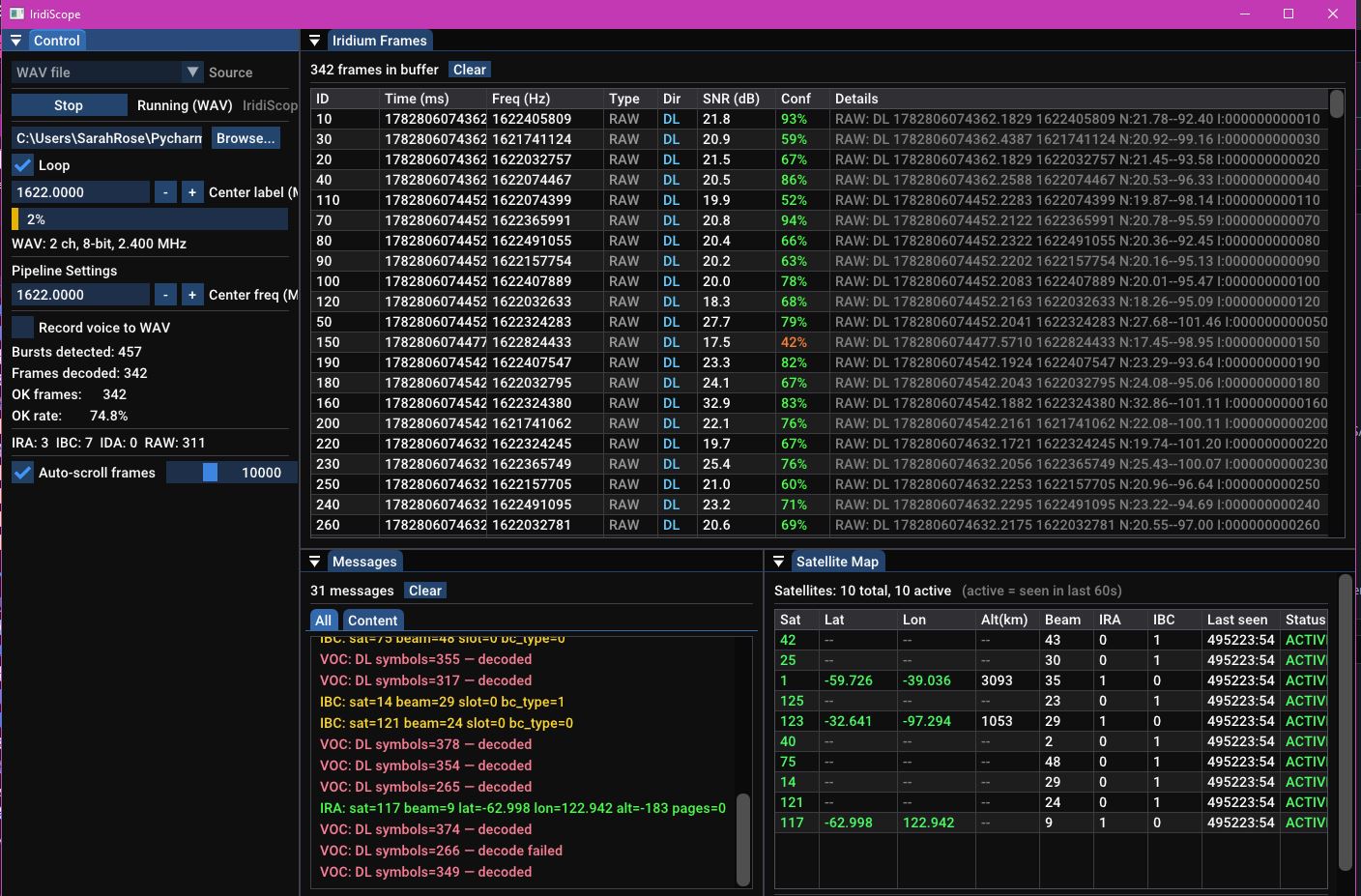
I already have the hardest piece working. Burst frames are the atomic unit of an Iridium transmission. Without clean burst detection, nothing else matters. And I have that. I also have IMSI decoding, which means I can identify individual subscribers and devices. That is a specific, valuable piece of information.
But the rest is still opaque. The call setup, the text messages, the location updates, the higher layer data. The signal is full of information, but my decoder only sees the skeleton.
That gap is what pulls me forward. This is not a simple reverse engineering project. It is a puzzle where the manuals are outdated, the waveforms are complex, and the system was designed to be resilient, not transparent. Every piece I add unlocks more. Every decoded message tells me where to look next.
Iridium has been in orbit for over two decades. The satellites are old, the hardware is fixed, and the protocol is documented in fragments. That makes it a perfect target for someone who likes to dig deep into signal processing and bitstream analysis.
So yes, this is my next development target. Not because it is easy, but because it is almost within reach. The burst frames work. The IMSI decoding works. The rest is just waiting to be cracked open.